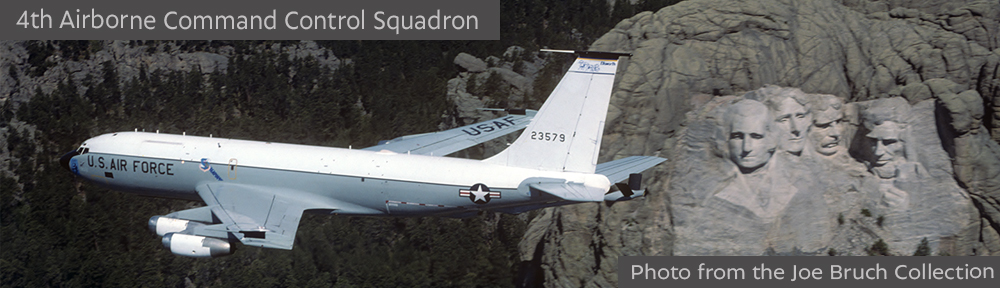
From 1 April 1970 to 30 September 1992, the 4th Airborne Command and Control Squadron, assigned to the 28th Bombardment Wing at Ellsworth Air Force Base, South Dakota, provided airborne command post responsibilities with specially modified Boeing EC-135 airborne command post aircraft for Fifteenth Air Force and Strategic Air Command as part of the Post Attack Command and Control System[1] The 4th was the workhorse of Airborne Launch Control System (ALCS) operations. Three dedicated Airborne Launch Control Centers (ALCC) (pronounced “Al-see”), designated ALCC No. 1, ALCC No. 2, and ALCC No. 3 were on ground alert around-the-clock providing ALCS coverage for five of the six Minuteman intercontinental ballistic missile (ICBM) Wings. These dedicated ALCCs were mostly EC-135A aircraft but sometimes were EC-135C or EC-135G aircraft, depending on availability. ALCC No. 1 was on ground alert at Ellsworth AFB, SD and during a wartime scenario, its role would have been to take off and orbit between the Minuteman Wings at Ellsworth Air Force Base, South Dakota and Francis E. Warren Air Force Base, Wyoming, providing ALCS assistance if needed. ALCCs No. 2 and No. 3 were routinely on forward deployed ground alert at Minot AFB, ND. During a wartime scenario, ALCC No. 3’s role would have been to take off and orbit between the Minuteman ICBM Wings at Minot and Grand Forks Air Force Bases, North Dakota, providing ALCS assistance if needed. ALCC No. 2’s dedicated role was to take off and orbit near the Minuteman ICBM Wing at Malmstrom Air Force Base, Montana, providing ALCS assistance if needed. The 4th ACCS also maintained an EC-135C or EC-135G on ground alert at Ellsworth as the West Auxiliary Airborne Command Post (WESTAUXCP), which was a backup to SAC’s Operation Looking Glass Airborne Command Post (ABNCP), as well as a radio relay link between the Looking Glass and ALCCs when airborne. Although equipped with ALCS, the WESTAUXCP did not have a dedicated Minuteman ICBM wing to provide ALCS assistance to.
Crews from the 4ACCS occasionally flew “Looking Glass” missions to back up the Strategic Air Command (SAC) airborne command post. The squadron flew the EC135A, C, and G models and was later deactivated, October 1992.
4ACCS COMMANDERS
Lt Col John A. Berlette 1 Apr ’70 – 31 Jul ’71
Lt Col Eugene Bal, Jr 1 Aug ’71 – 19 Nov ’72
Lt Col Ronald L Haase 20 Nov ’72 – 20 Aug ’73
Lt Col Bennie R Allen 21 Aug ’73 – 8 Jul ’74
Lt Col Clifford M Jackson 9 Jul ’74 – 1 Jul ’76
Lt Col Arvid S Doucette 2 Jul ’76 – 20 Apr ’77
Lt Col Robert B Picht 21 Apr ’77 – 15 May ’79
Lt Col Charles C Adams 16 May ’79 – 15 Jul ’81
Lt Col Clifford E Lambert 16 Jul ’81 – 3 May ’82
Lt Col Terry A Pratchett 4 May ’82 – 5 Jul ’84
Lt Col Arthur R Bode 5 Jul ’84 – 12 Aug ’85
Lt Col Carmen E Auwarter 13 Aug ’85 – 9 Jun ’87
Lt Col George M Xiques, Jr 10 Jun ’87 – 9 Jul ’89
Lt Col Frank Zazula, Jr 10 Jul ’89 – 12 Sep ’91
Lt Col H Richard Hodges, Jr 13 Sep ’91 – 1 Oct ’92
____________________________________________________________
Original Ellsworth AFB 44SMW-28BW ALCS crew list. Our Ellsworth bunch was the second crop of ALCS-er’s, behind those originally qualified at Offutt AFB for Looking Glass duty. (The FR/FV+6 or 7 digit number is the old USAF serial number for each individual, before we went to using SSN. Those numbers have been excluded.)
44SMW ALCC CREWS 1967 list for standup of the 4th ACCS at Ellsworth, combining the crew assets from Ellsworth and Minot. Gary Curtin was the first person to PCS out of the 4th ACCS, a few weeks later in late April 1970, enroute to SOS and the rest of his Air Force career.
___________________________________________________________________________________________
 “LOOKING GLASS”
An essential element in the command and control of the Strategic Air Command’s forces was the Airborne Command Post, also called “Looking Glass.” The nickname came from the mission – it was a mirror of the ground-based system. At least one airborne command post was in the air at all times and its highly-trained crew and staff ensured there was a viable means to direct bombers and missiles from the air should ground-based command centers become inoperable. It guaranteed that U.S. strategic forces would act only in the precise manner dictated by the President.
These aircraft began their duty with SAC on February 3, 1961. From then on, a Looking Glass aircraft was in the air at all times 24 hours a day, 365 days a year for more than 29 years. On July 24, 1990, Looking Glass ceased continuous airborne alert, but remained on ground or airborne alert 24 hours a day. Crews accumulated more than 281,000 accident-free flying hours. The last EC-135 was retired from service on October 1, 1998.
Another strong testament to the “Quality of the Leadership and Performance” in the Operations Deputate and 4ACCS! “It’s Safe to Say……….There’s Nothing You Guys Can’t Do!” Outstanding Mission Support
Brenda M. Brennan, USAF (Ret) – this was my first operational station in 1981 as a young “butter-bar”!!! Many fond memories!!! Pulling alert at Minot AFB, ND was NOT one of them…LOL!!!
Thinking back on those days brings tears to my eyes… especially now that all the ACCS aircraft were mothballed and then scrapped! I wish I could’ve gotten a piece of one of them… like the altimeter… which we were constantly resetting as we passed up and down through FL180. It’s sad to think that what filled all those years of my life… in my mind, one of the high points of my life… is gone. All I have left of that special time in my life are the memories… good… and bad. But I wouldn’t change a thing about my time at Ellsworth with the 4th ACCS!